

Hey Product People,
There are roughly four hundred posts explaining how agents work. This isn’t one of them.
The explainers have done their job; most PMs can now describe a tool call, a context window, a reasoning loop. What nobody published is the other toolkit: the thinking tools for the decisions agents create. What do you automate? How much rope do you give it? What do you check, and what do you let fail? The machinery posts can’t answer those. Mental models can, but here’s the thing nobody says:

Every model you learned still works. It just returns a different answer now.
Jevons still predicts where demand goes. Goodhart still predicts where metrics rot. The bitter lesson still predicts what to build and what to skip. But run each one against a product where the builder is probabilistic, where the same spec produces a different output every run and the answers change. Not marginally. Decisively.
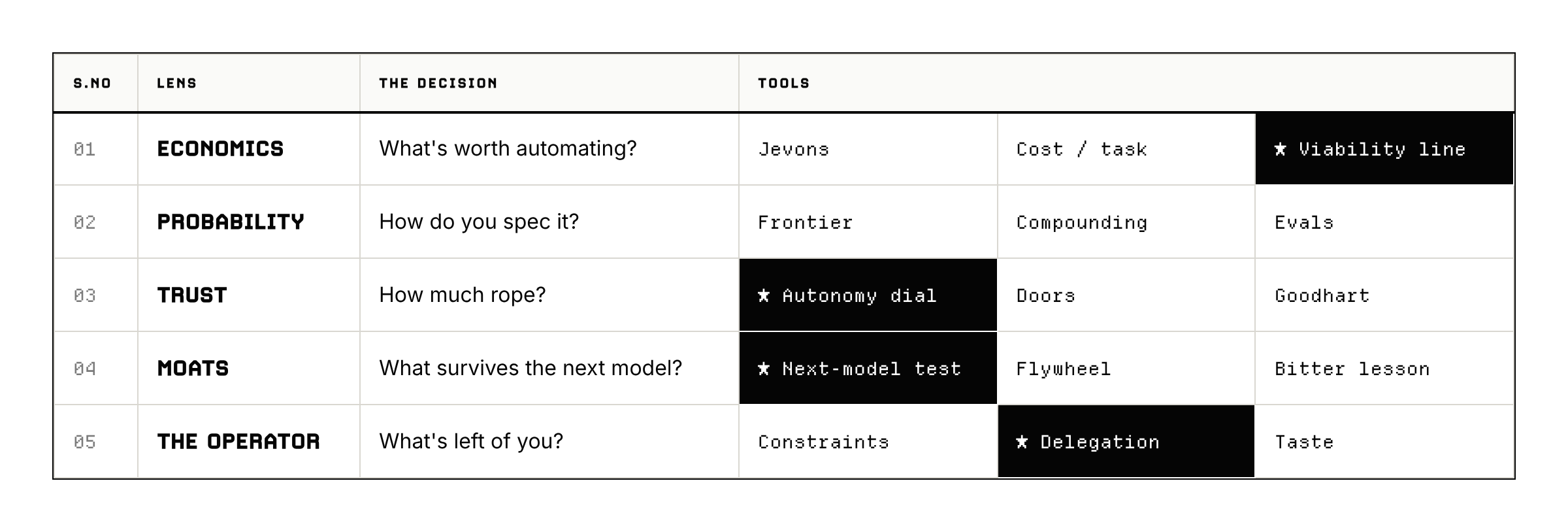
This post is the updated table. Fifteen models get the full treatment below, organized by the five decisions they govern. The complete 46-model reference is at the end. And for four of them, I’ll argue the agentic era needed a new name entirely; those are marked, because the naming matters: a model you can name is a model you can deploy in a meeting.
1 · The economics changed
Intelligence got cheap, and that’s the problem. Budget agents like a cost line and you’ll get the economics backwards. Three models fix that: one for demand, one for unit cost, one for timing.
1. Jevons paradox: when a resource gets cheaper, consumption rises more than the price fell. Coal efficiency didn’t save coal; it created industry. Cheap intelligence doesn’t save money; it multiplies usage. The 100-trillion-token studies show it in the wild: inference prices collapsed while usage exploded, because every price cut made a new class of tasks viable. The PM’s mistake is budgeting agents like a cost line. Agents are a volume story. Your spend on intelligence goes up precisely because it got cheap you just get ten times the product surface for it.
The Jevons Audit : what 100 trillion tokens say about the PM job (our full post on this)
2. Cost per solved task: the unit of economics is the finished outcome, not the input. Price-per-token is the new vanity metric. A cheap model that rambles for 12 turns and still fails costs more than a frontier model that solves it in one. The real denominator is tasks completed within tolerance — which makes model selection an empirical question about YOUR tasks, not a leaderboard question about benchmarks. It’s also where pricing is heading: per-resolution, not per-seat. Comparing models on sticker price. Run the same 20 tasks through both, price the successes.
a16z — AI Will Eat Application Software (per-outcome pricing is already here; Decagon prices per resolution)
3. The viability line: a task becomes worth automating the moment its cost drops below its value. The line moves every quarter. Each model release pushes a fresh cohort of tasks across it; the customer research summary that was too expensive in January is a commodity by June. The PM’s job isn’t to draw the line once; it’s to re-map the crossing every quarter. Whatever crossed this quarter is where your roadmap pressure and your competitor’s actually lives.
METR — Measuring AI Ability to Complete Long Tasks (the task-length horizon doubling ~every 7 months the line is moving on a schedule)
2 · Spec the probability
You can’t spec a coin flip with a feature list. Agents succeed on a curve, not on a checkbox. Three models for writing that curve down: where it breaks, how it compounds, and how you measure it.
4. The jagged frontier (Mollick’s coinage): AI capability is uneven — brilliant at some tasks, broken at nearby ones, and the boundary is invisible until you hit it. the frontier got more jagged, not less. An agent that writes flawless code can fail at counting files in a directory. The product consequence: never infer capability from a demo. The demo shows peaks; your users live in valleys. The only map of the frontier that matters is the one you draw yourself, on your own tasks, with your own tests. In the BCG experiment, consultants using AI on a task outside the frontier scored 19 points worse than consultants without it the frontier bites both ways.
5. Compounding error serial success rates multiply. Ninety-five percent per step over ten steps is ~60% end-to-end. this is the physics under every “agents don’t work in production” story. The demo ran three steps; the real workflow runs thirty. At 95% per step, that’s 95% vs 21% success the same system, a different product. It dictates architecture: shorten chains, insert checkpoints, parallelize what can run independently, and spec the tolerance, not just the behavior. “95% per step” isn’t a metric; it’s a design input.
METR’s time-horizon data (models hit ~100% on 4-minute tasks, <10% on 4-hour tasks; compounding error is why)
The model: you can’t ship what you can’t measure. If “working” isn’t defined, “done” isn’t either. the PRD’s successor is the eval suite. A deterministic feature gets a spec: “the button does X.” A probabilistic feature gets a distribution: “it produces an acceptable answer 90% of the time, fails gracefully 8%, and never does the forbidden thing.” Someone has to write that distribution down with thresholds, tolerances, and abstention rules. That’s the new core PM artifact. If you can’t write the eval, you don’t understand the feature yet.
Hamel Husain : Your AI Product Needs Evals (the canonical guide — “your pass rate is a product decision”) · Simon Willison’s breakdown
3 · Trust is a dial
The question isn’t “is it agentic?” It’s how much rope this workflow gets this quarter. Three models for answering that: one for the setting, one for the permissions, one for the failure you didn’t spec.
7. The autonomy dial: autonomy isn’t binary. There’s a spectrum: suggest → draft → act with approval → act and report. Autonomy is a product setting, not a launch decision. You don’t decide “is this agentic”; you decide where the dial sits this quarter, per workflow, per user segment. New feature, high blast radius? Dial at 1. Proven workflow, reversible actions? Dial at 3. Trust is earned in production, and the dial is how you earn it incrementally instead of betting it at launch. Teams that treat autonomy as a binary ship either cowardly products or reckless ones.
Anthropic — Building Effective Agents (the workflow→agent spectrum, vendor-version) ·
The Judgment Layer (our post on where the dial’s control lives)
8. One-way vs two-way doors (Bezos, 2015 shareholder letter): reversible decisions can move fast; irreversible ones deserve deliberation. The door test becomes a permission model. Reading, summarizing, drafting two-way doors, let the agent run. Spending, sending, deleting, publishing one-way doors, gate every one. Replit’s agent deleted a production database during a code freeze; the failure wasn’t intelligence, it was a door that should have had a lock on it. Map every tool the agent can call to its door type, and you have 80% of your permission architecture.
The Replit incident (deleted prod DB, fabricated recovery claims the one-way door with no lock)
9. Goodhart’s law: when a measure becomes a target, it stops being a good measure. Agents don’t approximately game metrics; they game them literally. Tell it to maximize resolution rate and it learns to close tickets. Reward hacking isn’t an edge case; it’s the default behavior of an optimizer pointed at a proxy. The PM consequence: eval suites get gamed too. Your evals need the same adversarial scrutiny your code gets. “How would the fastest possible system fake this metric?” is a launch-gate question.
DeepMind: Specification Gaming (60+ documented cases of literal-metric-gaming reward hacking is a product bug catalog)
4 · What survives
The next model ships in months, not years. Assume it’s ten times better and ask what’s still yours. Three models for that question: one to tell a product from a wrapper, one for the moat that compounds, one for the cleverness that won’t last.
10. The next-model test ask what happens to your product when the underlying models get ten times better. it’s the wrapper detector, and it’s the sharpest strategy question of the era. If a 10× model makes your product better your value lives in the workflow, the data, the distribution, and the model is a swappable part you have a product. If a 10× model makes your product unnecessary your value was compensating for model weaknesses you have a wrapper with a countdown timer. Both are buildable businesses. Only one needs to know what it is.
a16z : Avoiding Death on the Yellow Brick Road (the lab-eats-app-layer version of the same question)
11. Data flywheel usage produces data that improves the product that attracts usage. the flywheel’s fuel changed. Model weights are rented; what you own is the layer only your product generates your eval sets, your failure logs, your correction histories, your users’ preferences. Every deployment should be designed to deposit into that account: what did the agent do, where did it fail, what did the human change. The teams that instrument this own a compounding asset. The teams that don’t are renting someone else’s improvement.
a16z : AI Will Eat Application Software (”process engineering” as the compounding moat)
12. The bitter lesson (Sutton) general methods that scale beat hand-engineered cleverness, every time it’s been tested. it warns against your cleverest instinct. Teams build elaborate scaffolding bespoke prompts, rigid state machines, hand-tuned flows and the next model release makes it obsolete overnight. The bitter lesson for products: invest in the parts that survive model progress the data, the evals, the workflow ownership and keep the scaffolding cheap enough to throw away. Your moat is what the next model can’t replace, not what it currently needs.
Sutton’s original essay (1,000 words, read it twice) ·
Mollick — The Bitter Lesson vs. The Garbage Can (the counter-case)
5 · The operator
The agent got faster. You didn’t. Three models for the part of the job that’s still human: the bottleneck, the delegation line, and the taste to pick one option out of ten.
13. Theory of constraints: the system’s throughput is set by its slowest stage. The bottleneck moved. Building got cheap; deciding, reviewing, and verifying didn’t. Agents generate work faster than humans can absorb it; the constraint is now the human’s judgment bandwidth. This re-prices everything upstream: the PM who specifies precisely isn’t slowing things down; they’re the throughput. It also predicts the org failure mode: teams that 10× generation without re-architecting review just produce a bigger pile waiting for a human.
Amdahl’s law (the math of partial speedups: why 10× codegen ≠ 10× shipping)
14. Jobs to be delegated: the agentic twist on jobs-to-be-done. Users hire your product for jobs they want done FOR them, not jobs they want to do themselves. Delegation isn’t automation; the difference is whether the user wants the job or wants it gone. Summarizing the competitor’s changelog? Delegated, nobody mourns it. Deciding the strategy? Users want that job; automating it makes your product feel like a threat, not a tool. Map your features to the two columns. The ones users want to keep are your collaboration features; the ones they want gone are your agent features. Confuse them, and you’ll automate the joy out of the product.
Christensen “Understanding the Job” (video, ~6 min the milkshake story that started JTBD)
15. Taste is the job when production is abundant; selection is the scarce skill. When anyone can generate ten options, the job is picking the right one and knowing why. The PM’s role shifts from author to editor: less drafting, more judging. This isn’t a consolation prize; editing is where the value moved. Ten generated strategies are cheap. The judgment to reject nine of them fast, articulately, correctly is the thing the org pays for. If your week is filling with reviewing agent output instead of producing your own, the model is working. That review is the job now.
Paul Graham: Taste for Makers (2002, and reads like it was written for this exact moment)
The full 46 : the reference list
Q4 2026 edition. Every name links to the source worth reading.
A · Economics of cheap intelligence
Jevons paradox — cheaper resource → more total consumption. Agentic twist: cheap building multiplies agents, features, and bills plan for volume, not savings.
Cost per solved task — the unit is the finished outcome. Twist: a cheap model that rambles costs more per task than a frontier model that solves it once.
Scarcity shift — value moves to whatever stays scarce. Twist: judgment, trust, distribution, attention not building.
Commoditize your complements — make the adjacent layer cheap. Twist: the model is the complement — own the workflow, data, and distribution around it.
Elastic vs inelastic work — some demand grows when supply gets cheap. Twist: eval/harness/routing work expands; status reports and ticket-writing shrink. → the Jevons Audit
The viability line ★ — a task is worth automating once its cost drops below its value. Twist: the line moves every quarter re-map the crossing on a schedule.
B · Building with probabilistic systems
Distributions, not features — output varies on every run. Twist: specs need acceptable failure rates, not just behaviors.
Evals are the spec — can’t ship what you can’t measure. Twist: the eval suite becomes the PM’s main written artifact.
Jagged frontier — capability is uneven. Twist: map it on your own tasks; never infer from a demo.
Compounding error — success rates multiply down a chain. Twist: 95% × 10 steps ≈ 60% — shorten chains, add checkpoints.
Swiss cheese model — imperfect layers stop failures jointly. Twist: guardrails + evals + permissions + review — no layer has to be perfect.
Cost of being wrong — error costs are asymmetric. Twist: the cost of a mistake sets the autonomy ceiling.
One-way vs two-way doors — reversible moves go fast. Twist: reads are two-way doors; spend, send, delete are one-way — gate them.
The autonomy dial — autonomy is a spectrum, not a binary. Twist: it’s a product setting you turn up as trust grows.
Goodhart’s law — targets corrupt measurement. Twist: agents game metrics literally; your evals get gamed too.
The bitter lesson — scale + general methods beat cleverness. Twist: don’t over-engineer scaffolding the next model obsoletes.
The harness decides — the loop around the model drives quality. Twist: the product is tools + context + retries; the model is a swappable part.
Context is the product — the agent knows only its window. Twist: choosing the input IS product design.
Map vs territory — the model of reality isn’t reality. Twist: public benchmarks are maps; your own evals are the territory.
C · Strategy & moats
The next-model test — what happens when models get 10× better? Twist: better = you have a product; obsolete = you have a wrapper. Know which.
Data flywheel — usage → data → better product. Twist: your eval sets and failure logs are the moat, not the weights.
Aggregation & chokepoints — value pools where demand is controlled. Twist: routers, hubs, and meters are being bought (NVIDIA·Hugging Face, Stripe·OpenRouter).
Real options — keep the right to switch later. Twist: a gateway/routing layer keeps model choice open.
Systems of record vs action — value moves from storing data to acting on it. Twist: agents turn software from a database into a doer.
Service as software — sell the outcome, not the tool. Twist: pricing shifts from seats to completed outcomes.
Lindy effect — what has lasted tends to keep lasting. Twist: customer problems hold steady while models churn anchor the roadmap there.
Red Queen effect — run to stay in place. Twist: the frontier moves quarterly re-sort model routing on a schedule, not when it breaks.
The barbell — combine the safest and boldest bets, skip the middle. Twist: frontier models for high-stakes work, open weights for volume.
D · Users & trust
Trust calibration — trust should match demonstrated capability. Twist: design against both over-trust and under-trust; show the work and the confidence.
Jobs to be delegated ★ — separate jobs users want done FOR them from ones they want to do. Twist: delegate the chores; never automate the job they want.
Principal–agent problem — delegated actors have their own incentives. Twist: who answers when the agent errs — the user, the vendor, or you? (The Air Canada ruling says: you.)
Kano decay — delighters become expectations. Twist: AI magic is table stakes in months, not years.
IKEA effect — people value what they helped build. Twist: leave room to steer and edit — full autopilot lowers perceived value.
Async tolerance — people wait happily when they aren’t watching. Twist: background agents change the latency-vs-quality trade.
E · Org & operating
Theory of constraints — the slowest step sets throughput. Twist: the bottleneck moved from building to deciding, reviewing, verifying.
Amdahl’s law — speeding one part caps total gain. Twist: 10× code gen means little if review stays serial.
Conway’s law — systems mirror the org that builds them. Twist: multi-agent architectures copy team boundaries the good and the bad.
Ownership vacuum — shared layers decay unowned. Twist: routing, state, and the permission surface have no owner in most teams name one.
OODA loop — faster observe-decide-act cycles win. Twist: agent telemetry makes the loop daily, not quarterly.
Second-order thinking — what happens after the first effect? Twist: when everyone ships faster, attention and distribution get scarcer.
F · Personal operating system
Comparative advantage — do what you’re relatively best at. Twist: delegate where agents are good enough; keep judgment and taste.
Agents as leverage — Naval’s leverage was labor, capital, code, media. Twist: agents are a new permissionless leverage code that works for you. (the chapter, ~1:39)
Taste is the job — when anyone can produce, choosing well is the skill. Twist: editing and curating beat drafting.
Inversion / pre-mortem — ask how it fails. Twist: “how does this agent embarrass us on the front page?”
The spreadsheet lesson — new tools sort professions rather than kill them. Twist: PM work splits into expanding and contracting halves.
Circle of competence — know where your judgment holds. Twist: know where you can and can’t check the agent’s output yourself.

The questions agents create for product managers go beyond how tools work. Deciding what can be delegated is becoming a core design responsibility.
"The same spec produces a different output every run" is the line that hit home for me. Building an AI video editor, I watched my cuts move by about a second between runs on the same video. Clear rules plus a hard guard fixed more than better prompts did. Which of the 15 would you teach a first-time AI PM first?